
Rhinoplasty Consultation & Imaging
Understand What’s Possible for Your Rhinoplasty
Your consultation with Dr. Athré combines a detailed evaluation of your goals and anatomy with a discussion of what may be realistically achieved through surgery.
Dr. Athré will examine your nasal structure and facial proportions, review your concerns, and discuss potential changes based on your anatomy and aesthetic goals. Clinical photography and 3D imaging may also be used to help you visualize and discuss potential surgical outcomes.
Rhinoplasty consultations at Athré Facial Plastics typically last 45 minutes to one hour.

The Rhinoplasty Examination
When the consultation starts, Dr. Athré will ask the most important question:
“If you had a magic wand, what would you do?”
Most rhinoplasty patients have a clear idea of what they would like to change about their nose. Rhinoplasty is seldom an impulsive decision, and many patients spend months or even years considering what they would like to change.
After the initial questions, Dr. Athré will perform a complete examination. The examination includes factors such as:
- Gender
- Height
- Skin color
- Skin thickness
- Skin sebaceousness
- Facial symmetry
- Facial proportions
- Projection of upper jaw (maxilla)
- Projection of jaw
- Chin projection
- Ethnicity
Dr. Athré then performs a thorough examination of the internal and external structures of the nose. He evaluates its overall shape, proportions, and alignment; the position and straightness of the septum; the amount and quality of available cartilage; the structure and movement of the nasal tip; and how the nose relates to other facial features, including the upper lip.
Rhinoplasty Consultation Process
What Dr. Athré Evaluates During Your Rhinoplasty Consultation
Successful rhinoplasty requires the surgeon to take into account every variable.
During your initial consultation, Dr. Athré will evaluate these factors, perform a physical examination, and discuss your concerns and aesthetic goals.
Height of the Patient
Overall Facial Shape
Skin Color
Skin Texture
Patient’s Ethnicity
Facial Bone Structure
Patient’s Aesthetic Sense
Rhinoplasty Imaging & Assessment
Dr. Athré will develop a surgical plan based on all of the above information and your own goals.
Using Photography and 3D Imaging to Refine Your Surgical Plan
During the initial portion of the consultation, photographs are taken. These photographs are then used during the imaging and planning discussion. Dr. Athré will review these photos with you to discuss your nasal anatomy and aesthetic goals before using 3D imaging to illustrate potential changes.
Dr. Athré uses 3D computer imaging to help illustrate how your nose might look after surgery. The system used in our office is the VECTRA 3D system. The VECTRA system creates a three-dimensional simulation that can help you visualize potential changes to your nose in the context of your face.
Despite the VECTRA 3D system being state of the art, it still has limitations. Because the software can digitally model changes that may not be surgically achievable, the simulation must be interpreted in the context of each patient's anatomy. However, the changes that can be achieved are constrained by factors such as cartilage, bone, skin and soft-tissue characteristics, scar tissue, and prior surgery. For this reason, Dr. Athré performs the imaging himself so he can keep the simulation within what he believes is surgically achievable for that patient's anatomy.
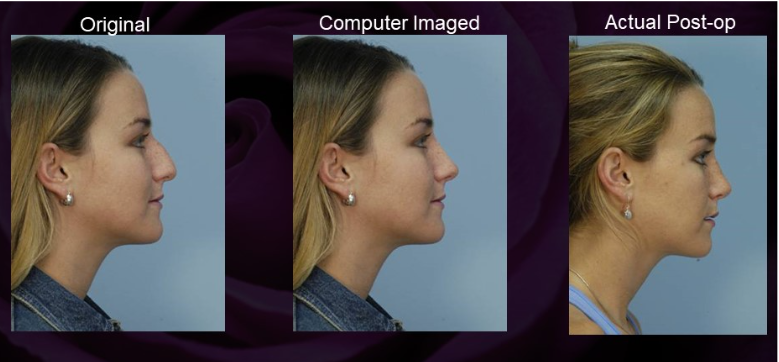
The above image portrays this very well. In this patient's case, the postoperative result differs from—and in Dr. Athré's assessment improves upon—the preoperative simulation.
While at other practices computer imaging might be performed off-site or by other ancillary personnel, Dr. Athré performs all of his own computer imaging. This allows the operating surgeon to evaluate the simulation in the context of the patient's anatomy, goals, and what he believes can realistically be achieved during surgery.
Another limitation of rhinoplasty simulation can be the accuracy of frontal-view modeling. The realism of profile imaging, as shown above, is very good. Profile-view changes may be easier to visualize than some frontal-view changes; however, simulation accuracy varies by the feature being modeled and should not be treated as a prediction of the surgical result. Frontal-view simulations may be less useful for illustrating certain three-dimensional changes and should be interpreted cautiously. A simulated change may not be surgically achievable because the result depends on the patient's anatomy, tissue characteristics, healing, and surgical variables. Hence, Dr. Athré refrains from frontal imaging to minimize miscommunication with his patients with respect to expectations. In Dr. Athré’s words, “My job is to promise Paris, Texas, and deliver Paris, France. Not the other way around.”
There are some special situations where Dr. Athré will not offer imaging.
Revision rhinoplasty is one of these situations. The rationale for this is simple.
- First, some revision rhinoplasty patients' noses are so deviated that it is impossible to use a simulation based on their nose to create a simulation that is aesthetic and demonstrative to the patient. In severely deviated or complex revision cases, a digital simulation may not provide a realistic representation of what can be achieved surgically.
- Some revision rhinoplasty patients may also not be candidates for simulation because anatomy, scar tissue, and changes from previous surgery can limit what can realistically be achieved surgically.
If Dr. Athré feels that his imaging and modeling skills would either give the patient a false expectation or not accurately depict what he can achieve in the operating room, he may elect not to perform 3D modeling.
3D modeling is a communication tool. It is intended to facilitate communication about realistic surgical goals—not to allow patients to select an arbitrary nose shape. It is a communication tool that helps you and Dr. Athré discuss potential changes and establish realistic surgical goals.
The final portion of your consultation will include a surgical plan, a discussion of the risks of surgery, a description of your preoperative and postoperative periods, and your estimate for surgery.