
Open vs. Closed Rhinoplasty
Which Option is Right for You?
Rhinoplasty can generally be performed using one of two surgical approaches: open or closed rhinoplasty.
Closed rhinoplasty is a type of rhinoplasty where all the incisions are inside the nose. Open rhinoplasty uses the same internal incisions as closed rhinoplasty but adds one incision across the columella. That incision is placed across the columella (the strip of skin separating the nostrils).
About Open vs. Closed Rhinoplasty
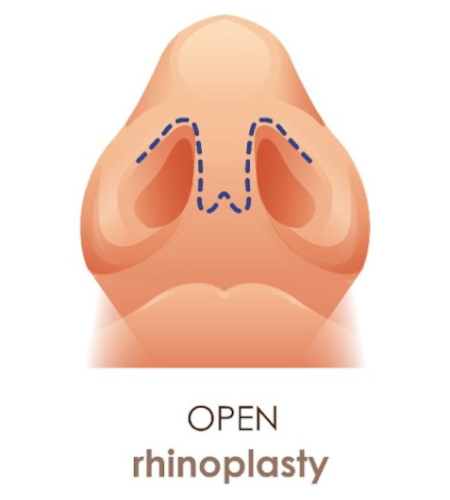
Open Rhinoplasty
Open rhinoplasty developed after closed rhinoplasty and is commonly used for revision rhinoplasty because it provides greater visualization of altered or scarred nasal structures.
Open rhinoplasty uses the same incisions with an additional incision on the columella. The primary advantage of open rhinoplasty is greater direct visualization of the nasal structures. The additional columellar incision allows the surgeon to elevate the skin and soft-tissue envelope for greater exposure of the nasal structures. Open rhinoplasty is widely used by rhinoplasty surgeons, particularly for complex cases requiring greater surgical exposure.
Surgeons also prefer the open technique for complicated rhinoplasty surgeries where the nose might be twisted or crooked.
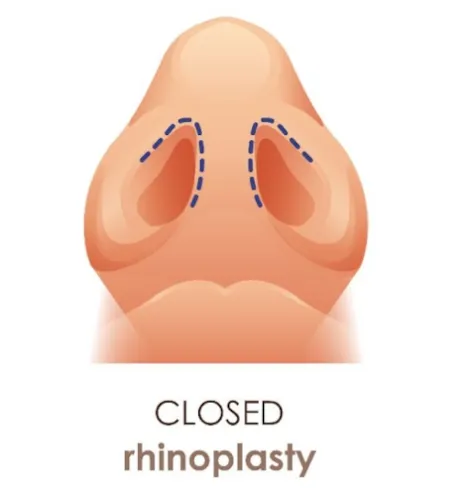
Closed Rhinoplasty
Up until the 1970s, most rhinoplasty surgeries used the closed technique. Another name for the closed rhinoplasty technique for nasal surgery is the delivery technique.
In this technique, the surgeon makes incisions inside both nostrils.
Through these incisions, Dr. Athré can dissect around and expose the lower lateral cartilages. After separating the lower lateral cartilages, they can be “delivered” into either nostril to change them. That is why the closed technique is also known as the delivery technique.
The closed rhinoplasty technique has some advantages over the open technique for nasal surgery. The closed technique can be quicker than the open technique.
Closed rhinoplasty can require the surgeon to work through more limited exposure and therefore demands substantial experience with the technique. One limitation of the closed approach is reduced direct visualization of some nasal structures. Because the surgeon works through internal incisions, direct visualization of some nasal structures is more limited.
COMPARING TECHNIQUES
Choosing Between Open and Closed Rhinoplasty
Surgeons may favor different rhinoplasty approaches based on their training, experience, and the needs of each patient. One commonly discussed difference is whether the surgical approach affects postoperative swelling.
Some surgeons primarily use an open approach, while others have greater experience with closed rhinoplasty. Surgeons may favor one approach based on their training, experience, and the types of cases they treat.
Surgeons who favor the closed approach may argue that closed rhinoplasty produces less postoperative swelling than an open approach. Dr. Athré does not believe this to be true.
Several variables are related to swelling after rhinoplasty surgery.
- The amount of surgery needed (primary or revision rhinoplasty)
- Precision of the dissection and elevation
- Precision of local anesthesia injection
- Type of local anesthesia injected
- Amount of time in the operating room
Revision rhinoplasty procedures may take longer due to scarring and can involve more postoperative swelling. Previous trauma and longer or more extensive surgery can contribute to increased postoperative swelling. These factors can substantially influence postoperative swelling, so the surgical approach alone does not determine how much swelling a patient experiences.
One concern sometimes raised about open rhinoplasty is the external columellar incision and the possibility of a visible scar. When carefully closed, the columellar incision typically heals with a small scar that can become difficult to see over time. Scar appearance varies by patient and healing response. For this reason, Dr. Athré does not consider the possibility of a visible columellar scar, by itself, a reason to avoid an open approach.
A surgeon’s training and experience with open and closed rhinoplasty can influence which approach they use most frequently. Dr. Athré has trained extensively in both techniques.
Dr. Athré performs different types of nose surgery and considers patient features when choosing the best technique.
Patients who may benefit from an open rhinoplasty include:
- Revision rhinoplasty patients
- Patients whose noses are significantly crooked
- Patients whose nasal structures are scarred and skewed
- Patients with a history of repeated nasal trauma and resulting scar tissue
For these patients, an open approach may provide better visualization of the nasal structures that require correction. A patient with a small hump and no major nose injury or crookedness may benefit from a closed procedure.
A recurring theme in all these technique pages is that there is no single technique that is right for every patient. Both open and closed rhinoplasty have advantages and limitations. The surgeon’s skill and experience are more important than choosing one technique simply because it is open or closed.
Dr. Athré is experienced in both open and closed rhinoplasty. Dr. Athré continues to refine his surgical techniques and adapt his approach to individual patients. This experience with both approaches allows Dr. Athré to select and adapt the technique based on each patient’s anatomy and surgical goals.
Why Choose Dr. Athré for Rhinoplasty?
Dr. Athré performs both primary and revision rhinoplasty and treats patients from Houston as well as patients who travel from outside the region.
He uses both established and evolving rhinoplasty techniques, adapting his surgical approach to the patient’s anatomy and treatment goals.
Approximately 75-80% of Dr. Athré’s rhinoplasty practice is primary rhinoplasty, with revision rhinoplasty being 20-25% of his practice. Rhinoplasty represents a substantial portion of Dr. Athré’s surgical practice, including both primary and revision cases. His practice also receives rhinoplasty referrals from other physicians.
Patient Review
“Dr. Athré did an amazing job on my nose. His staff treated me like family and I felt very comfortable getting the work done. He was very intuitive on what I was trying to accomplish and knowledgable enough to work through the issues involved to get the result I wanted, especially considering it was a revision surgery. The whole experience was great and helped me so much!”